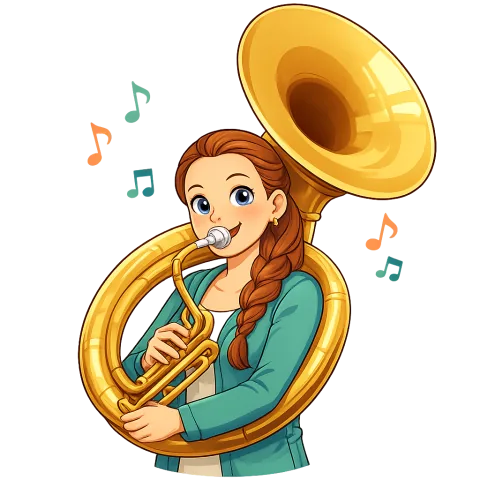
The instrument should meet the musician
A tuba is large, but the player should not have to disappear behind it, hold a painful pose, or stretch toward the mouthpiece.
Body size alone does not decide who can play tuba. Chairs, instrument models, playing supports, and setup choices all affect access.
The first goal is not a note. It is a stable arrangement that leaves the player free to breathe, move the valves, see the conductor, and protect the instrument.
Begin with the chair and floor
Use a firm chair at the height assigned by the teacher. Sit far enough forward that both feet can support the body, but not so far that balance feels uncertain.
Clear the area of cases, backpacks, and loose music. A tuba needs a predictable path into and out of playing position.
If the feet do not reach a stable surface or the chair creates an awkward angle, tell the teacher. A foot support, different chair, or approved setup change may solve the problem.
Place the tuba before adjusting the player
Follow the program’s instructions for where that specific instrument rests. Depending on the model and player, it may sit on the chair, thigh area, floor, or an approved tuba support.
The instrument should not balance on a fragile slide, valve cap, brace, or bell edge. Do not improvise a support with unstable books, bags, or furniture.
Once the tuba is supported, check that:
- the mouthpiece reaches the lips without the head jutting forward;
- the shoulders stay level and movable;
- the valve hand can remain naturally curved;
- the supporting hand touches a strong, teacher-approved part;
- the music stand and conductor remain visible.
Change the instrument position before asking the body to twist around it.
Make a silent setup rehearsal
Before playing, practice the sequence:
- approach the chair and instrument;
- move the tuba using the taught grip points;
- settle it into playing position;
- place both hands;
- bring the face to a neutral forward position;
- lower the instrument safely.
Repeat slowly until no step requires a sudden catch or grab.
A young player may need an adult or teacher to move a school-owned instrument. That is responsible instrument care, not a lack of independence.
Add the breath only after the setup works
With the instrument balanced, release the shoulders and jaw. Take a comfortable breath without forcing the chest against the tubing.
Play one teacher-assigned note for a short count. Let the air begin the vibration, and keep the body available for the next breath.
Tuba playing uses a generous air stream, but “more air” does not mean holding an oversized breath until the body becomes rigid. Rest between attempts and build endurance gradually.
If the mouthpiece shifts when the player inhales, return to the physical setup.
Move the valves without moving the whole instrument
Rest the fingertips on the valve buttons. Press straight down and release fully.
Watch for:
- a wrist bent sharply to reach the valves;
- fingers pushing sideways;
- the entire tuba rocking with each note;
- the supporting hand squeezing a slide;
- a valve that does not return freely.
These are setup or maintenance clues. Do not solve them by gripping harder.
Set the instrument down deliberately
Follow the teacher’s exact procedure. Some tubas rest safely only in a particular orientation or on a stand. A bell placed on an unsuitable surface can be dented, and an upright instrument can tip when bumped.
Before walking away, confirm that the tuba is stable and outside traffic paths. Never leave it balanced on a chair unless that storage position is specifically approved and supervised.
Ask for a different solution when needed
Tell the teacher if the player experiences pain, numbness, restricted breathing, an unreachable mouthpiece, or a valve hand that cannot operate comfortably.
An approved support, alternate chair, different tuba model, adapted reach, or revised part assignment may improve access. A good tuba setup does not ask the student to prove commitment by tolerating strain.
When the instrument is balanced first, the player can spend attention on the things that make music: breath, pitch, rhythm, resonance, and the bass line’s place in the ensemble.