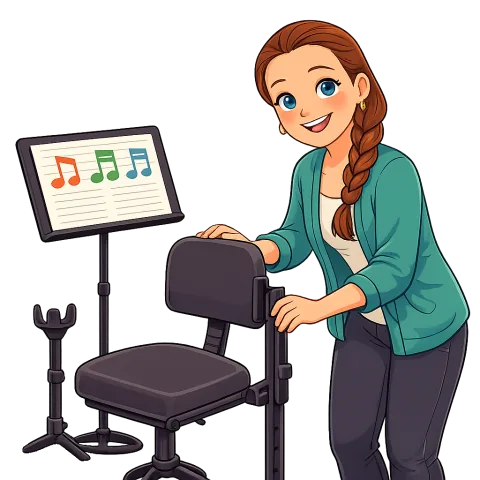
Access is part of instruction
A student may understand the music and still face a barrier involving:
- printed notation;
- hearing or vision;
- instrument position;
- fine or large movement;
- transitions;
- memory or attention;
- sensory load;
- communication;
- fatigue;
- performance format.
An accommodation changes access to the task. It does not automatically remove the musical goal.
The question is:
What is preventing this student from showing or developing the musicianship we are teaching?
Begin with strengths and the student’s experience
Ask what already works:
- Does the student learn quickly by ear?
- Do visual schedules reduce uncertainty?
- Is a demonstration clearer than a long explanation?
- Does seated access improve control?
- Does extra transition time prevent rushing?
- Can the student explain the part in another way?
Include the student in an age-appropriate conversation.
Do not make every plan around what adults assume is difficult.
Involve the music teacher early
Share relevant information before:
- instrument selection;
- a new unit;
- seating assignments;
- marching or staged movement;
- auditions;
- concerts;
- travel.
The music teacher can explain the essential musical and safety requirements. A classroom, special-education, accessibility, therapy, nursing, or health professional may contribute within their role.
Follow the student’s existing educational or medical plan where applicable. Families and music teachers should not replace the qualified team by inventing a separate diagnosis.
Name the goal and barrier separately
For example:
- Goal: enter after eight measures of rest.
- Barrier: losing place in a visually dense page.
- Possible access: enlarged part, clearer measure numbers, approved cue, or a visual countdown.
Or:
- Goal: produce an intentional steady pulse.
- Barrier: the assigned grip is not usable.
- Possible access: approved adapted grip, different implement, alternate motion, or another sound source.
Separating the goal from one traditional method creates room for good teaching.
Consider several kinds of access
Information
- shorter instructions;
- written and spoken directions;
- demonstration;
- preview vocabulary;
- visual rehearsal order;
- teacher-approved recording;
- captions or transcript when available.
Notation
- enlarged or reformatted music;
- uncluttered copy;
- measure numbers;
- high contrast;
- approved color or symbol cues;
- alternate notation paired with standard notation;
- accessible digital format.
Environment
- seating with a useful sightline;
- a quieter preparation location;
- predictable transitions;
- appropriate hearing protection;
- lighting adjustment;
- planned breaks;
- clear pathways.
Equipment and response
- adjusted chair or stand;
- instrument support;
- approved adaptive grip or control;
- additional setup time;
- an alternate way to demonstrate the same musical understanding;
- a partner role that preserves active participation.
Not every option is appropriate for every student or instrument. Test one change and observe its effect.
Preserve meaningful challenge
An accommodation should not quietly turn a musician into an observer.
Ask:
- Does the student still make musical decisions?
- Can the student hear or feel progress?
- Is the part important to the ensemble?
- Is instruction moving toward greater independence where appropriate?
- Are adults helping only as much as needed?
High expectations and flexible access can exist together.
Protect dignity and privacy
Discuss personal information only with people who need it for the plan.
Do not require a student to explain a disability, diagnosis, medication, or accommodation to peers.
Teach the ensemble that musicians may use different:
- stands;
- chairs;
- notation;
- hearing protection;
- grips;
- movement routes;
- communication methods.
Fair does not always look identical.
Plan for performances and emergencies
Rehearse:
- entering and leaving the stage;
- equipment placement;
- page turns;
- transitions;
- who assists if needed;
- what happens if the plan stops working.
Do not wait for concert night to discover that a path, light level, riser, uniform, sound level, or instrument position is inaccessible.
Safety concerns, pain, breathing difficulty, sudden sensory or medical changes, and equipment failure require the appropriate adult response—not pressure to finish the piece.
Review what happened
After several rehearsals, ask:
- Did access improve?
- Did the musical goal remain clear?
- What did the student do more independently?
- Did the accommodation create another barrier?
- What should be adjusted next?
Document the useful strategy so the student does not have to begin from zero with every new piece or teacher.
The best music plan does not ask whether a student “fits” one fixed classroom. It asks how knowledgeable adults and the student can build a safe, rigorous route into shared music making.