The wrong note may be very close
The horn’s long tubing creates many available notes with the same fingering. As the player moves higher, those notes sit increasingly close together.
This is part of the instrument—not evidence that the student lacks talent.
A beginning horn player needs more than a fingering chart. The ear must learn which note the music is asking for, and the body must learn a repeatable way to begin it.
Set the instrument before choosing the pitch
Use the chair, posture, and holding position taught by the director or horn teacher.
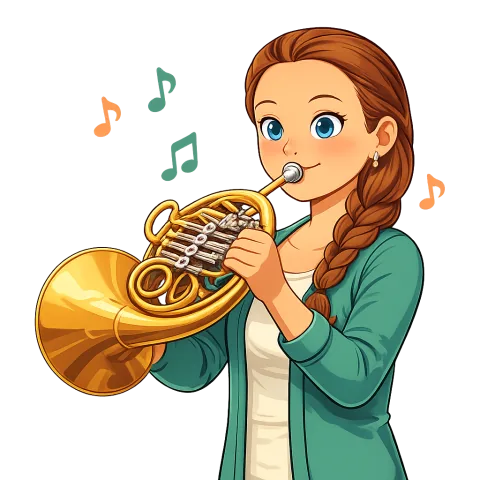
The left hand operates the levers. The right hand rests inside the bell in the program’s normal open position and also helps support the instrument. The hand should not randomly open, close, or move deeper whenever a pitch misses; those changes affect tone and pitch.
Bring the mouthpiece to the player without collapsing the chest or twisting the neck. Let the instrument’s weight be supported safely rather than hanging from the left little finger alone.
If the program uses single, double, or marching horns, follow the specific fingering and trigger instructions for that instrument.
Hear, sing, and then play
Choose one comfortable note assigned by the teacher.
Listen to it. Sing it on a neutral syllable. Hear it silently once more.
Then:
- take a relaxed breath;
- keep the corners and jaw in the teacher’s starting position;
- send steady air through the center of the sound;
- let the note speak;
- rest before trying again.
The sung pitch does not need a solo voice. It only needs to be recognizable enough to guide the attempt.
Learn the feeling of two neighboring notes
With a teacher-approved pattern, compare two nearby notes that use the same or closely related fingerings.
Play the lower note several times with a rest between attempts. Then do the same with the upper note. Avoid racing back and forth until each one can begin independently.
Next, sing lower–upper, finger the pattern silently, and play it slowly.
Notice what changes without exaggerating it. The upper note may use a slightly faster or more focused air stream and a different internal shape. It should not require a clenched throat or crushing mouthpiece pressure.
Treat a cracked note as information
If the note lands too low, the player may have selected a lower partial, lost the target internally, or changed the air direction.
If it jumps too high, the player may be anticipating with too much tension or sending an abrupt air burst.
If it wavers between notes, return to separate starts. Listen, sing, play, and rest.
If the sound changes when the right hand moves, restore the teacher’s normal hand position before adjusting anything else.
Do not chase a miss by pressing the mouthpiece harder. Excess pressure can reduce endurance, make response less predictable, and cause discomfort.
Use the section as a reference, not a hiding place
In rehearsal, listen across the horn section for the note’s center and character. Enter with the group rather than waiting to copy the sound after everyone else begins.
During individual practice, a teacher-approved drone, piano, or reference pitch can help. Turn it off after several attempts and see whether the note remains in the ear.
The goal is growing independence, not permanent dependence on another player.
Stop when the setup needs expert attention
Ask the teacher to check the instrument when:
- the correct notes suddenly become unavailable;
- levers or rotors move slowly or noisily;
- slides, strings, or linkages look displaced;
- the mouthpiece or leadpipe is damaged;
- every note responds with unusual resistance;
- playing causes pain, numbness, or persistent swelling.
Finding horn notes is ear training, coordination, and patience. A missed partial is a normal event. The useful response is to reset the sound in the mind—not to punish the face.