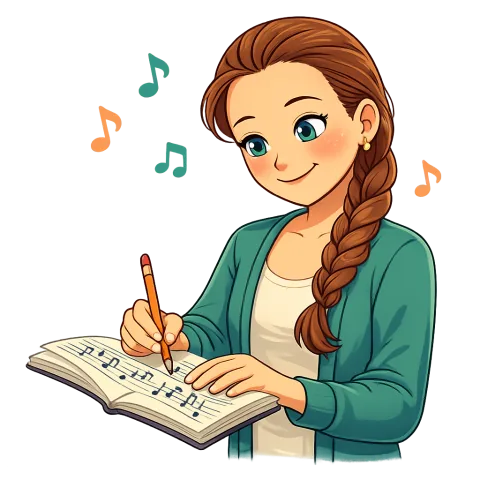
A finished piece can be very small
Composition does not have to begin with a blank page and five minutes of music.
A first complete piece might contain:
- four or eight beats;
- three approved pitches;
- two percussion sounds;
- one repeated rhythm;
- a beginning, change, and ending.
Limits do not make the music less creative. They make the choices easier to hear.
Decide the job of the piece
Choose a simple intention:
- a wake-up signal;
- a quiet answer;
- a marching pattern;
- music for tiptoeing;
- a musical question;
- a short celebration.
The intention is not a rule that every listener must interpret identically. It gives the composer something to test.
Ask:
What should the listener notice?
Build one recognizable idea
Create a short rhythm or melodic shape that can return.
Try:
- clapping a word rhythm;
- arranging note cards;
- improvising on a teacher-approved note set;
- singing a comfortable two- or three-note pattern;
- choosing a sound followed by silence.
Repeat the idea before adding more. If nothing returns, the listener may not know which sound matters most.
Put the idea inside a frame
Choose a plan such as:
- A–A–B–A
- question–answer
- sound–sound–silence–sound
- soft beginning–growth–clear ending
The letters are labels, not required sounds. “A” simply means an idea comes back.
Keep a steady pulse unless changing the pulse is part of the teacher-approved plan.
Save the first draft
Use the notation system the class understands:
- standard notes and rests;
- rhythm syllables;
- letter names;
- icons or a sound map;
- an authorized recording;
- a combination of these.
The draft needs to remind the composer what to do. A final version should also give another performer enough information to try it.
Add a title and the composer’s name.
Test with real sound
Perform the entire draft without stopping to repair each beat.
Then ask:
- Was the main idea recognizable?
- Did the piece fit the agreed number of beats?
- Could the performer tell when to begin and end?
- Did the sound match the intention?
- Was any part unsafe, unclear, or outside a comfortable range?
A composition can work differently in the imagination and in the room. Testing is part of creating.
Revise one feature at a time
Choose one purposeful change:
- add a rest before the ending;
- repeat the strongest rhythm;
- remove an extra sound;
- change the dynamic shape;
- move one pitch;
- make the answer the same length as the question;
- clarify the notation.
Write the reason:
I added a rest so the final sound would feel surprising.
Revision is not punishment for a bad draft. It is how the composer makes an idea easier to hear.
Ask for descriptive feedback
The listener can answer:
- “What did you hear return?”
- “Where did the music change?”
- “What moment sounded most complete?”
- “Was any instruction hard to follow?”
Avoid turning feedback into a contest or rewriting the piece for the composer.
The composer decides which suggestion supports the intention.
Make a final copy
Prepare a readable version. Include:
- title;
- creator;
- instrument or voice;
- tempo or character word;
- notation key if special symbols are used;
- clear ending.
If the piece borrows a teacher-provided rhythm, public-domain tune, or another creator’s material, identify that source and follow the teacher’s rules.
Share, notice, and keep creating
Perform the final version. Name one decision that improved during revision.
The next composition can change one boundary: add another pitch, use a partner, lengthen the form, or write for a different classroom instrument.
Finishing teaches something endless improvising cannot: a musician can imagine, choose, test, revise, communicate, and let another person bring the idea to life.